
Original submission details
Original title: KEATS love-hate relationship: Servitisation in Higher Education – A Strategic Response for Global Online Learners
View original KEATS context ↗ (university access required).
1.8 Servitisation considerations
Servitisation as a global competitive strategic response: why do we embark on servitisation? Design and innovation for servitisation: what is needed to realise servitisation? The processes of servitisation transformation: how do we implement servitisation?
Course task reproduced as context. The response below is Fiona’s independent academic work. KEATS source ↗ (university access required).
Explore writing on this question ↗Having worked through this week’s materials, it’s clear that servitisation—the transformation of product-centric organisations into service-oriented providers—isn’t just relevant to manufacturing or B2B firms. It’s becoming a critical competitive strategy in higher education, especially for institutions like King’s College London offering online postgraduate programmes to international cohorts.
1. Servitisation as a Global Competitive Strategic Response
For King’s, servitisation isn’t optional—it’s strategic. In the context of delivering an online Master’s in Marketing to students from Saudi Arabia, Norway, Colombia, India, China, and Japan, servitisation is how the university ensures the experience of education is as premium and globally relevant as the content itself.
As Vargo and Lusch (2004) argue in their service-dominant (S-D) logic, value is not embedded in the product (in this case, the degree), but co-created with the user during the service interaction. Students are not just passive recipients of modules; they are active participants in a collaborative learning experience that must be sensitive to culture, time zone, language, and professional context.
What makes servitisation especially critical in this environment is that education is intangible and high-involvement—it requires deep trust, sustained engagement, and emotional investment (Zeithaml et al., 2020). Without a fully integrated service mindset, King’s risks delivering a “good degree” without a “great experience”—which is where true value lies.
2. Design and Innovation for Servitisation
Servitisation cannot exist without intentional design. The needs of global students are complex: A student in Colombia may be working full-time while studying at night, while one in Japan may value structure and punctuality over flexibility. A student from Saudi Arabia may prefer direct tutor interaction and tailored support, whereas one from Norway may expect independence and a peer-driven learning model. True story.
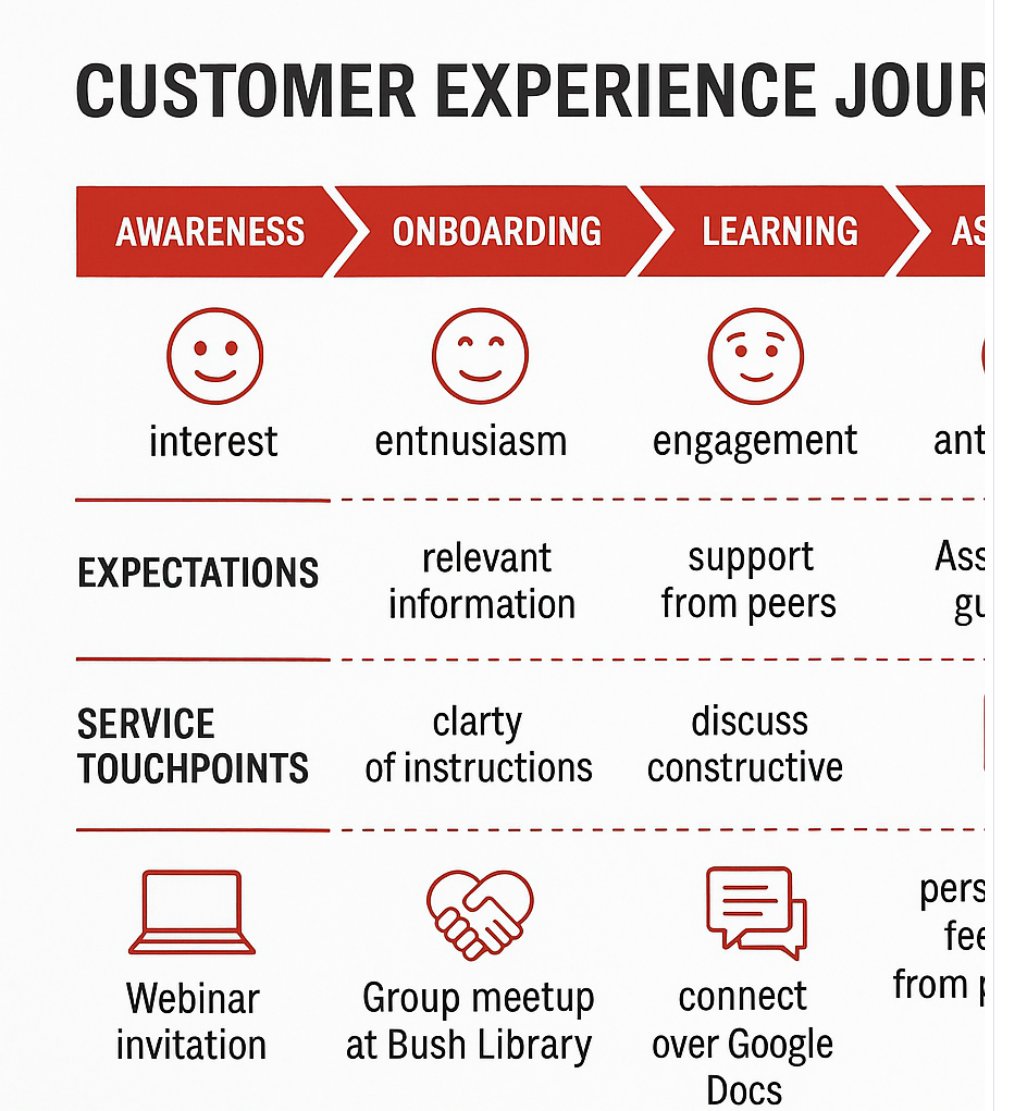
This diversity calls for a service design that is empathetic, adaptive, and intuitive. As Lovelock and Wirtz (2016) highlight, successful service innovation depends on understanding the service blueprint—mapping out every touchpoint a student encounters. From onboarding emails to virtual discussion forums, each element must feel purposeful and human.
Importantly, the system must not feel like a system. Online learners don’t want to navigate layers of admin—they want clarity, responsiveness, and connection. As Bitner et al. (2008) note in their work on the servicescape, the virtual learning environment must communicate professionalism, ease, and belonging through interface design, tutor tone, and academic content. This is particularly vital for students from high-context cultures like China and India, where indirect communication and prestige cues strongly shape perceived value (Hofstede, 2001). 3. The Processes of Servitisation Transformation
Transforming into a servitised university means embedding service logic into every part of the student journey. This includes:
Internal culture shift: Everyone from academic staff to IT support must adopt a hospitality mindset. The goal is not to teach at students but to guide with them, flexibly and respectfully. Digital enablement: Learners across multiple time zones require asynchronous access, AI-supported study reminders, and responsive tech support. The KEATS platform, for example, must become more than a resource hub —it must feel like a personalised study companion. Proactive support and feedback: Following Grönroos’ (2007) framework on value creation, support should not only be reactive (when problems arise) but also anticipatory. For example, nudging a student who hasn’t logged in for five days, or offering optional live check-ins around assessment periods.
Critically, customer experience management (CEM) becomes central to how King’s competes. According to Lemon and Verhoef (2016), managing experiences across the entire student lifecycle—from pre-enrolment to alumni status to job/career enhancement —is what builds trust and drives long-term reputation. It’s not about offering more features; it’s about offering better feelings—certainty, motivation, pride. Ivy legues Oxford and Cambridge capitalized on this heavily. We can to.
Conclusion
Servitisation is how King’s College London sustains its elite status in a digital, borderless educational market. By treating students not as “users of a platform” but as partners in an immersive experience, King’s can deliver emotional resonance, academic excellence, and cultural sensitivity across continents. The future of higher education doesn’t lie in content delivery, but in experience design. And that starts with thinking less like a traditional institution—and more like a trusted, global learning concierge providing a top notch life enhancing service.
Images from the original
References.
- Bitner, M. J., Ostrom, A. L. and Morgan, F. N. (2008) Service Blueprinting: A Practical Technique for Service Innovation, California Management Review, 50(3), pp. 66–94.
- Grönroos, C. (2007) Service Management and Marketing: Customer Management in Service Competition, 3rd edn. Chichester: Wiley.
- Hofstede, G. (2001) Culture’s Consequences: Comparing Values, Behaviors, Institutions and Organizations Across Nations, 2nd edn. Thousand Oaks: Sage Publications.
- Lemon, K. N. and Verhoef, P. C. (2016) Understanding customer experience throughout the customer journey, Journal of Marketing, 80(6), pp. 69–96.
- Lovelock, C. and Wirtz, J. (2016) Services Marketing: People, Technology, Strategy, 8th edn. Harlow: Pearson.
- Vargo, S. L. and Lusch, R. F. (2004) Evolving to a New Dominant Logic for Marketing, Journal of Marketing, 68(1), pp. 1–17.
- Zeithaml, V. A., Bitner, M. J. and Gremler, D. D. (2020) Services Marketing: Integrating Customer Focus Across the Firm, 7th edn. New York: McGraw-Hill Education.
Archive notes
Editorial clarification: Oxford and Cambridge are not Ivy League members. The original wording is retained. The Ivy League’s official membership is listed at https://ivyleague.com/sports/2017/8/13/HISTORY_0813173057.aspx .
Some embedded material is omitted where it contains personal details, other people’s writing, or no article content. Available article images are shown with source captions.