
Original submission details
Original title: 🛑🙂 Stop. Don’t Read This If Your Name Is Willem: Confessions of a 20-Year Marriage
View original KEATS context ↗ (university access required).
2.6 Can passionate activism lead to positive change_
1. Do you think anger is an effective tool for environmental advocacy? Why or why not? 2. How about passionate activism more broadly? Do you think it leads to positive change, or does it risk alienating potential supporters?
Course task reproduced as context. The response below is Fiona’s independent academic work. KEATS source ↗ (university access required).
Explore writing on this question ↗No one should share this with my husband. I will deny it unequivocally to save pride and face. That said, I have learned a lot about activism from my marriage, my kids, and my many failed attempts at in a latin way yelling my way to positive change. I am not a relationship expert, a parenting guru, or someone who has life figured out. Human nature is complicated, and most of what I think I know has come from doing things the wrong way first.
For example, yelling at my husband does not work. I can be tired, correct, and deeply committed to my argument, and still nothing gets done. The moment blame enters the room, progress is out the door digging the whole even deeper! What works instead, and this annoys me every time, is encouragement. Even when he wants recognition for putting a dish next to the dishwasher instead of inside it. Apparently, if I want the dish to travel the final twelve inches tomorrow, I have to say thank you today.
What makes this even more inconvenient is that it works both ways. When he calmly points out things I could do better, without attacking me, I actually listen. When he grits his teeth and flairs his nostrils, I shut down immediately. I stop hearing the message and start preparing my defence. The issue is no longer about solving a problem. It becomes about protecting myself at all costs. Yes, Im a very proud person. Aren't most of us?
Parenting has reinforced this lesson daily. If I come at my child with frustration and list everything they are doing wrong, the message is lost instantly, my dad called it the teflon effect, nothing will stick. But if I start with praise and make the request feel reasonable and achievable, rewardable, suddenly there is cooperation. Even more so if I explain that it will not dramatically cut into Minecraft time. That detail alone can decide whether anything happens at all.
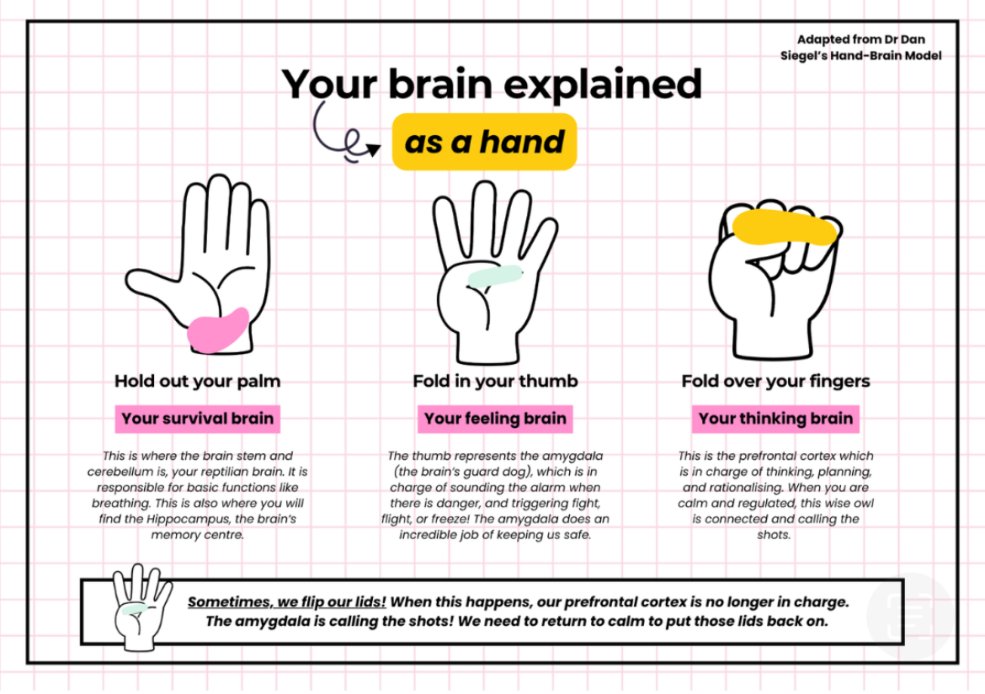
A child psychologist once explained this to me using a simple brain model popularised by Dan Siegel. When people feel attacked or threatened, the thinking part of the brain shuts down and survival mode kicks in. It does not matter if the person is an adult, a child, or someone being told they are personally responsible for fixing the planet. Once that defensive switch flips, logic and learning are no longer in charge. This is where I think a lot of environmental activism runs into trouble. Constant urgency and anger can work for a while, but eventually people hit a wall. There comes a point where you throw your arms up in the air and say, I give up, fuck it. Not because you do not care, but because you are exhausted. We are surrounded by doom-filled headlines, endless calls to action, and reminders of everything that is going wrong. It becomes all too much, more than we can handle!!! On top of also loading the damn dishwasher picking up your kid on time and needing to go to the grocery store and spend time on looking for the organic b corp product!! In the 15 min you have to do it all! The human brain cannot stay in crisis mode indefinitely without checking out. The elastic band of our nervous system stretches too far and snaps.
When that happens, people do not become more motivated. They become numb. They disengage. They scroll past. And then we wonder why the message is not landing.
What seems to work better, at least in my very unscientific experience, is encouragement, humour, and realistic expectations. People are more likely to keep going when they feel noticed for what they are already doing, even if it is small. Separating recycling or making one better choice is not going to fix everything, just like one clean dish does not fix a kitchen. But it is a start. And starts matter when they are supported instead of dismissed.
So yes, I think passionate activism can lead to positive change. But I think it has to follow the same rules that apply at home. Less yelling. More connection. Some encouragement. And an understanding that people, and all relationships, do better when they feel capable rather than constantly scolded.
And again, if my husband ever reads this, I take it all back.
Images from the original
References.
- No references were listed in the original contribution.