
Original submission details
Original title: Music online
View original KEATS context ↗ (university access required).
1.11 Presenting your brand map
Create a post in this discussion forum and share your two brand maps, adding a brief description of them. If you have hand-sketched your maps, you will need to take a photo of them and upload with your discussion post. Include your thoughts about the identified competition for the product or service selected under the two scenarios.
Specifically, try to figure out how the competitive landscape has changed, and consider some possible reasons you can think of as to why. Some of it, not all, may have been driven by the pandemic but challenge yourself to ask what about the pandemic led to the changes.
Course task reproduced as context. The response below is Fiona’s independent academic work. KEATS source ↗ (university access required).
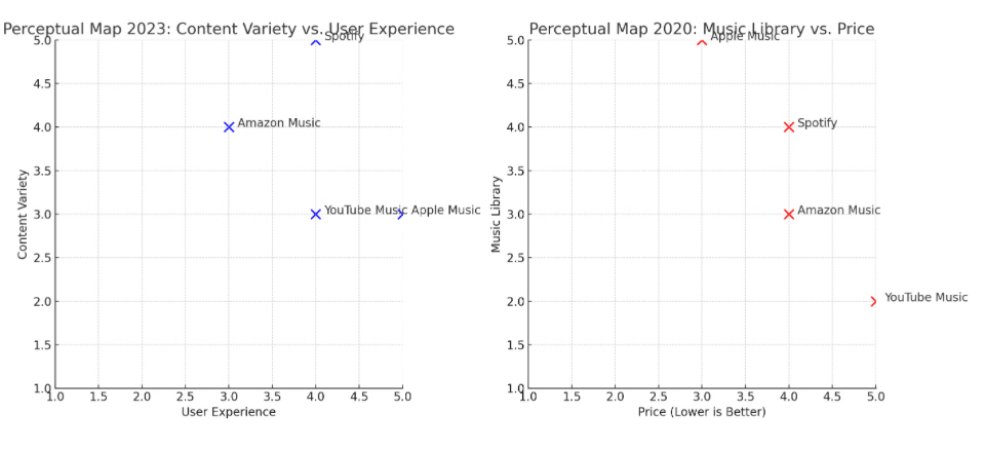
Explore writing on this question ↗2023 (Current) - Content Variety vs. User Experience:
Spotify is placed in the top-right quadrant, because it has high content variety and great user experience. Apple Music ranks high on user experience but lower in content variety. In my opinion but perhaps I have not taken the time to figure it out. Amazon Music offers decent content but lower user experience according to mu friend but that could just be their experience and opinion. YouTube Music ranks lower in both content variety and user experience although my teen daughter says I’m wrong.
2020 (Earlier) - Music Library vs. Price:
Apple Music leads with the strongest music library but I stopped because it was expensive. Spotify and Amazon Music have comparable music libraries, with reasonable pricing. So I felt they were neck and neck until Amazon made it part of prime. Nice move. YouTube Music scores lower on music library but offers alot for free.
In my opinion the competition has shifted from focusing on Music Library and Price in 2020 to Content Variety and User Experience in 2023. If I have done this correctly it would look like Spotify appears to have strengthened its position in content variety while maintaining a good user experience, making it more competitive today.
As for why they made these changes off the top of my head I remember licensing issues, integration of Alexa That made us use more Amazon products so smart device integration became a thing with all the brand collaborations. Like I mentioned before the Amazon bundling in the subscription versus Spotify is well price subscription for the family. Also for me, Spotify did not mean just for music at one point it became also audiobooks so multi use because I think they saw how many subscribers during the pandemic were on audible and audible prices went up and we had to tighten her belt during the pandemic we had to jump ship. And I think a major factor was the development of algorithms that show you more and more things that you will like and suck you in down the rabbit hole further and further.
Let me know if this is what you meant with the exercise. Best Fi
Images from the original
References.
- No references were listed in the original contribution.