
Original submission details
Original title: 🐾 “Branding the B2B Beast”: When Trust Has to Carry the Whole Practice 🧠💼
View original KEATS context ↗ (university access required).
3.4 Try it out_ assess a B2B branding example
For this activity, you will need to choose an example of a B2B firm; you may want to revisit the B2B firm you identified and discussed with your classmates in week 1, or you may choose a different firm.
1. What specific benefits and challenges might branding impose on your chosen firm? 2. Is this firm branding at either the corporate level or product level? 3. Why do you think this is appropriate from the firm’s perspective?
Course task reproduced as context. The response below is Fiona’s independent academic work. KEATS source ↗ (university access required).
Explore writing on this question ↗Hi,
I like the way this discussion opens up the question of whether B2B branding should sit at the corporate level or the product level. Using Heronden Vets as an example, my added thought is that in service-based B2B relationships, the corporate brand often has to do much heavier lifting than a single product or service. It is not just there to look polished on a website or make the reception sign behave itself. It has to reduce perceived risk, signal competence, and reassure customers and partner businesses that they are dealing with a practice they can trust.
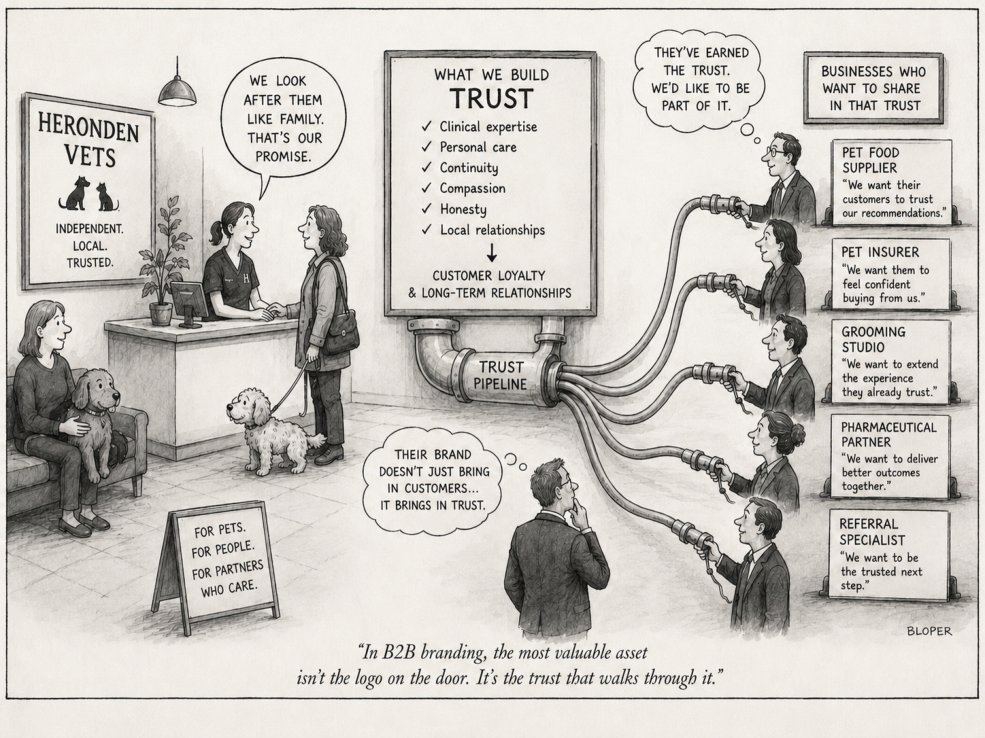
This is especially important because veterinary branding is built around trust before purchase. Customers often cannot fully judge the clinical quality of a veterinary service in advance, so they rely on reputation, word of mouth, professional credibility and the emotional reassurance of the brand. Heronden Vets has already created that bond with its customers: people trust the practice with animals they love. That trust is a valuable brand asset, and it also has B2B value because other businesses may want to be associated with it.
For example, a pet food supplier, groomer, insurer, pharmaceutical company, referral partner or local animal business may want to work with Heronden not just because it provides access to customers, but because those customers already have a relationship of trust with the practice. In other words, the partner is not only buying visibility; it is buying into the trusted relationship Heronden has already built. It is a bit like saying, “You have created that bond with the customer we would quite like to stand close enough for some of that trust to rub off.” Very strategic, if slightly waggy-tailed. From a brand equity perspective, this fits Keller’s view that brand value comes from what customers know, feel and associate with the brand, because brand knowledge shapes how they respond to marketing activity (Keller, 1993). For Heronden, those associations might include local independence, compassion, clinical competence, continuity of care and personal service. These associations do not only make Heronden more attractive to pet owners; they can also make Heronden more attractive to partner firms that want customers to see them through the same trusted lens.
I also think the challenge is that corporate branding can become risky if it is not managed carefully. Heronden’s brand promise is not just about offering veterinary services; it is about care, trust and relationship continuity. If another business partners with Heronden, that partner becomes part of the customer’s perception of the Heronden brand. A poor partner could damage the trust Heronden has spent years building. So the “rub-off effect” works both ways: good partners can strengthen the brand ecosystem, but bad ones can make the whole thing smell less like strategy and more like a wet dog in a waiting room.
Glynn (2012) argues that B2B brands can create value by improving information efficiency and reducing perceived decision risk, particularly where products or services are complex. That is useful here because veterinary services involve emotional and technical complexity. Customers want expertise, but they also want reassurance. For partner businesses, Heronden’s corporate brand can act as a credibility shortcut, helping customers feel more comfortable with linked recommendations, services or collaborations.
For this reason, I would argue that Heronden’s branding is most appropriate at the corporate level. Individual services such as consultations, diagnostics, surgery or preventative care matter, but the real value sits in the Heronden name and the relationship customers have with it. Product-level branding could still work for specific services or care plans, but the main strategic power comes from the corporate brand because it carries the trust across the whole customer journey.
Overall, the key benefit of Heronden’s B2B branding is that it can build trust, reduce uncertainty and create partnership value. The key challenge is making sure the brand promise is protected across every touchpoint and every association. Otherwise, the firm risks doing the marketing equivalent of putting a bow tie on a spaniel and calling it brand strategy: charming, but not quite enough to carry the business.
Images from the original
References.
- Glynn, M. S. (2012). Primer in B2B brand-building strategies with a reader practicum. Journal of Business Research, 65(5), 666–675.
- Keller, K. L. (1993). Conceptualizing, measuring, and managing customer-based brand equity. Journal of Marketing, 57(1), 1–22.