
Original submission details
Original title: coding
View original KEATS context ↗ (university access required).
6.9 Discussion_ Qualitative data analysis
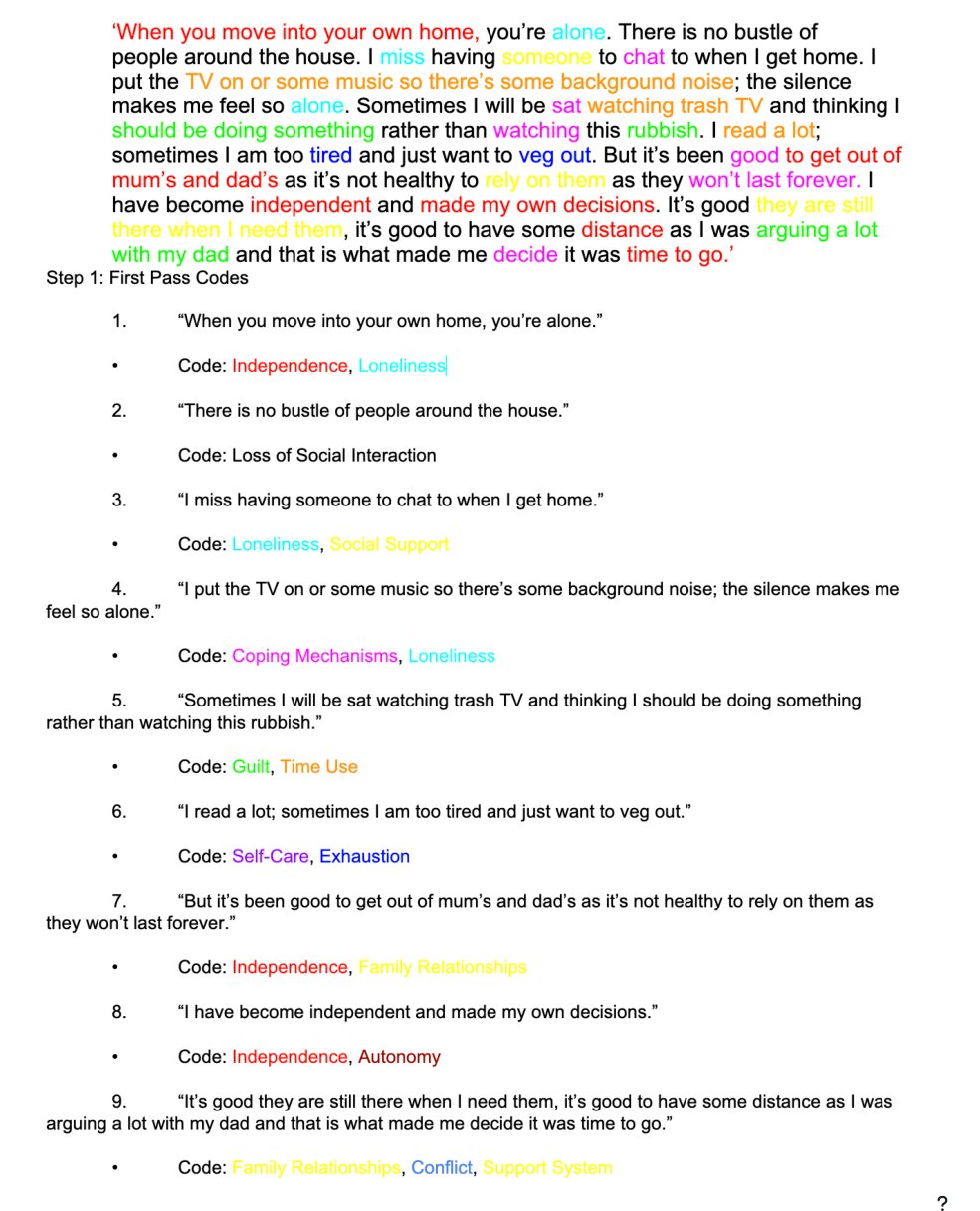
Download the transcript below and write down some codes that would help you to identify categories and themes. Then go through the transcript and mark on the transcript how you would code various parts of the interview.
Compare your response to the solution below, then share your coded transcript (eg by taking a photograph) and reflections in the discussion forum.
Course task reproduced as context. The response below is Fiona’s independent academic work. KEATS source ↗ (university access required).
Explore writing on this question ↗Step 2: Second Pass Codes to Categories Grouping the first pass codes into broader categories that reflect recurring themes.
1. Loneliness
• Feeling alone after moving out
• Missing social interaction
• Using TV/music as a coping mechanism
2. Coping Mechanisms
• Watching TV
• Listening to music
• Reading
• Allowing time to rest (veg out)
3. Independence
• Moving out of parents’ home
• Becoming self-reliant
• Making independent decisions
4. Family Relationships
• Conflict with father
• Support from parents at a distance
• Recognizing the need to detach for personal growth
5. Guilt and Time Use
• Feeling guilty about watching “trash TV”
• Awareness of time management
Step 3: Document the Process
This process involves a systematic progression:
1. Initial notes and codes were assigned to highlight recurring ideas in the transcript.
2. Similar codes were grouped into categories to identify themes like loneliness, independence, and coping mechanisms.
3. Themes for Further Analysis
• Emotional Transition: The emotional impact of moving out, highlighting loneliness and guilt.
• Adaptation Strategies: Coping mechanisms used to adjust to the new living situation.
• Growth and Independence: The benefits of autonomy balanced against the challenges.
• Evolving Family Dynamics: Navigating relationships with parents post-move.
Images from the original
References.
- No references were listed in the original contribution.